
Trigger warning: This article discusses topics related to sexual violence.
Strong Women: Self-Defense, Sisterhood, Justice, and Personal Safety
Learning from Bonobos About Sisterhood and Collective Self-Defense
This month, Andrés Picado was finally sentenced to 24 years in prison for crimes committed between 2019 and 2022, including the sexual assault of five foreign women and two girls, aged 13 and 14, in Santa Teresa.
This sentencing is a significant victory for the women of Cóbano and Santa Teresa, especially for those who have been fighting for justice for over two years. It also represents a win for women across the country, who have raised awareness about these cases through organized protests, marches, posts, and collective action to support the process. Their tireless efforts aim to create a safer community for all women.
Will this serve as an example to deter other aggressors in the region? We hope so.
In the meantime, I feel a shared sense of gratitude as justice is served—a gratitude that is evident across social media. Yet, this gratitude is accompanied by other emotions: frustration, exhaustion, and a persistent undercurrent of anger.
As I read posts from women’s collectives, I think about how much effort and energy countless women poured into holding one perpetrator accountable.
How many women had to raise their voices? How many women had to protect themselves and others?
While this case brought some form of justice, the broader system does not protect us. The judicial and legislative systems, created by men, serve their interests—not those of women or marginalized groups.
If so much effort is required to achieve justice against one perpetrator, how much more is needed to combat patriarchal violence as a whole?
How many voices must cry out, “He is a rapist,” before we are believed?
How many girls must be assaulted before authorities take action?
How many similar cases must we endure before we see significant change in a patriarchal culture that enables men to maintain power over women?
I want to believe that this case will catalyze judicial change.
Yet, I remain frustrated by the immense energy spent on this—a collective energy that could have been channeled into other projects, dreams, and simply living our lives. On the other hand, this case also reminds me of the strength and tenderness that emerge when women unite.
Learning From Bonobos About Sisterhood
This brings to mind The Bonobo Sisterhood, a book by Diane Rosenfeld about the solidarity of bonobos. Here’s the concept: Bonobos, our closest genetic relatives, share 97% of our DNA. In their social structure, there is no male-on-female violence. In rare instances when a male exhibits violent tendencies, the other females intervene to punish and expel him from the group. They protect each other, even if they are not related or acquainted. This collective defense ensures that male violence never gains a foothold.
Patriarchy has maintained its power by isolating us—keeping women confined at home, chained to kitchens, drowning in domestic labor, and distant from one another. This separation prevents women from sharing, validating, and affirming their experiences.
However, the world has changed, and we are no longer isolated. We are talking more about our experiences and realizing that we are not alone. Many of us share similar stories, turning these burdens into shared experiences rather than solitary weights.
In our work to teach and share the Holistic Self-Defense Methodology, we emphasize five core principles, one of which is “to speak out.” How is speaking out a form of defense, especially after a violent act? Speaking about our experiences is a healing act. It connects us, strengthens sisterhood, and allows us to hear a reassuring “me too.” This validation is a crucial step in driving cultural change.
The Power of Community
A few months ago, I met a young woman who had recently moved to our town. She seemed sad and confided that she didn’t have many friends. Her boyfriend had told her she didn’t need friends—that the women in our town were all crazy.
“Wow, that’s a red flag,” I told her.
I assured her that not only are we not crazy, but we are also well-connected. I explained that in our community, there is a strong network of women who watch out for one another. Women here would have her back, fight for her, and protect her—even if they didn’t know her.
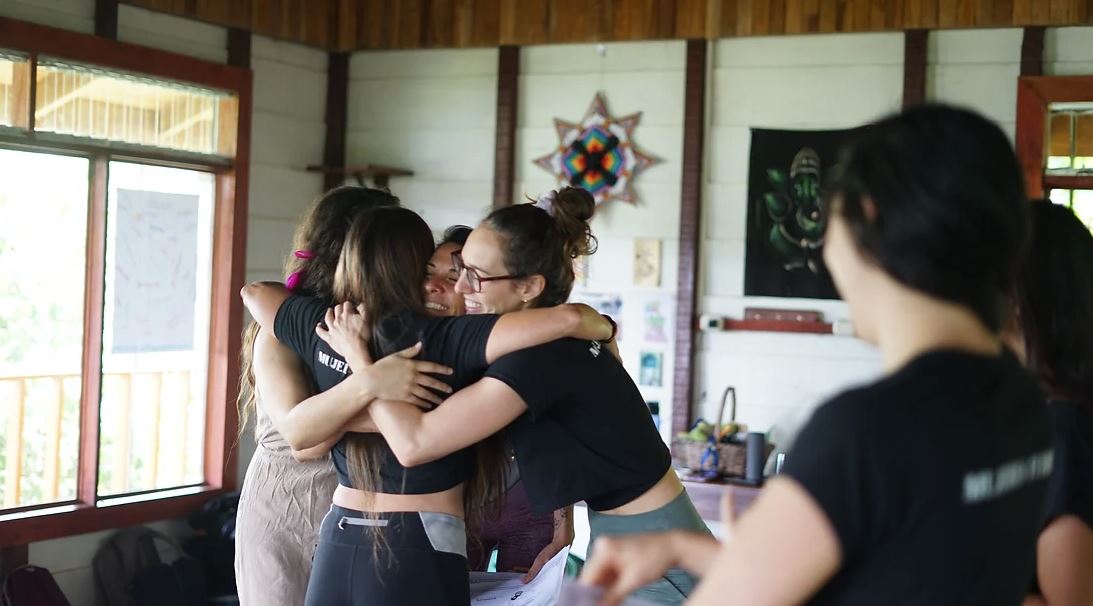
This is true. In many towns, women defend, support, and protect one another, even if they’ve never met. There are formal collectives and informal networks of women fighting for our safety.
When one woman is harmed, we all feel it. It hurts us all.
Without knowing it, we are organizing like bonobo females.
And like them, to feel safer, we protect each other. We follow their example to begin building a society free from patriarchal violence.
Achieving justice shouldn’t require such immense effort and energy. Let’s continue working toward a world where we don’t have to demand justice because we’ve eradicated violence at its roots—a world where aggressors are expelled from our communities, where we protect one another, and where we focus on what unites us rather than what divides us.
About the Author
Amy is a Level 1 self-defense facilitator certified by ESD Global in 2018. She lives in Samara, Costa Rica, where she facilitates self-defense classes, courses and workshops. Amy is also a writer, editor, and yoga instructor. She likes to dance, walk on the beach with her dog, laugh with friends, and fight the patriarchy with her written words.
Originally Published in Mujeres Fuertes Autodefensa.
